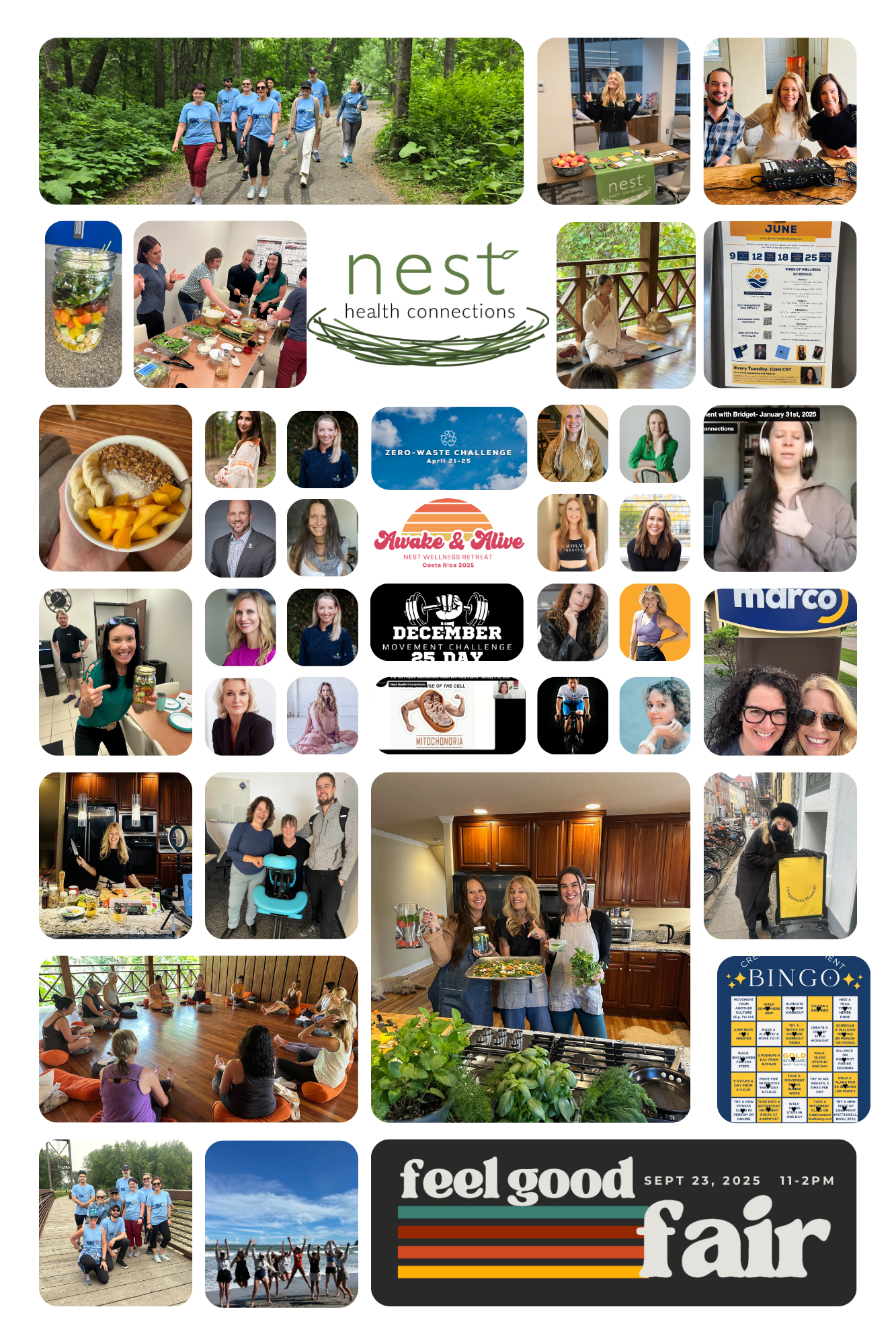
CONNECTIONS Is in Our Name
When I started Nest Health Connections, the word connections wasn’t an afterthought. It was the very first word I landed on.
As I begin my ninth year of building Nest, after nearly a decade of working alongside employees, leaders, clinicians, and thought leaders across the country, one thing is clear to me: connection is the missing metric in corporate wellness.
Most corporate wellness firms measure steps, attendance, and engagement scores.
But the thing that most influences health, resilience, and performance often goes unmeasured and under-designed: how connected people feel to themselves and to each other.
Why connection matters more than ever
The data backs up what many of us feel intuitively.
Social disconnection is linked to higher risk of heart disease (29%) and stroke (32%)
Chronic loneliness carries a mortality risk comparable to smoking
About 1 in 5 employees report feeling lonely at work, with remote and younger employees reporting it most often
Loneliness isn’t just emotional.
It’s a health issue, a performance issue, and a retention issue.
And yet, many workplace wellness programs still focus almost entirely on individual behavior change.
Eat better.
Move more.
Manage stress.
All important. But people don’t sustain healthy behaviors in isolation, especially in high-pressure work environments.
What we see from our seat at Nest
At Nest Health Connections, we work across industries, geographies, and workforce models. On-site teams. Fully remote employees. Hybrid environments. Executives. Frontline staff.
Because we collaborate with SMEs, clinicians, and thought leaders, and because we design real-world experiences, not just programs on paper, we see patterns clearly.
Here’s what consistently shows up:
Connection drives participation
People are far more likely to engage when something feels welcoming, social, and human.Connection lowers the barrier
When someone joins because a coworker invited them, not because HR told them to, participation changes.Connection supports nervous system health
Feeling seen, included, and supported directly influences stress regulation, focus, and emotional resilience.
How we intentionally design connection
Connection doesn’t happen by accident. It has to be designed, repeated, and normalized.
Some of my favorite examples from our programs:
Tiny Wins + Acts of Kindness Challenges
These challenges are intentionally simple.
Notice one small win
Offer one small act of kindness
Reflect on how it feels
What happens is powerful. Employees start seeing each other. Encouraging each other. Celebrating progress instead of perfection.
Virtual 5Ks and movement challenges
These aren’t about racing. They’re about invitation.
Employees are encouraged to invite a coworker or teammate. Remote employees don’t need to be in the same place to feel part of something shared.
10 at 10: daily connection in motion
10 at 10 is one of our favorite examples of connection by design:
10 minutes of live, virtual movement every weekday at 10:00 a.m.
Employees join together on (Microsoft) TEAMS from home offices and corporate locations, step away from their desks, and move as a community. Cameras on or off. No prep. No pressure.
It’s simple, repeatable, and incredibly effective.
Movement becomes the excuse. Connection is the outcome.
Group experiences that lower walls
Cooking demos. Sound bowl experiences. Short nervous system resets. Walk-and-talk weeks.
These experiences create connection without pressure. You don’t need to overshare or be extroverted. You just need to show up.
Manager-led connection moments
We support leaders with simple tools and prompts.
How to check in as a human
How to recognize effort
How to create psychological safety in small, repeatable ways
Because managers are the biggest connection multipliers in any organization.
Why connection is infrastructure, not a perk:
You would never build a company without communication systems.
Connection is just as foundational.
When connection is weak, we see:
Higher stress and faster burnout
Lower participation in wellbeing offerings
Less help-seeking behavior
Increased turnover risk
When connection is strong, everything else works better.
Movement sticks.
Habits stick.
Culture strengthens.
Measuring what actually matters
You don’t need a massive survey to start measuring connection.
A few powerful pulse questions can tell you a lot:
I feel seen and valued at work
I have someone I can rely on here
I can ask for help without negative consequences
Someone checked in on me as a person this week
You can also track connection behaviors:
Peer invitations into challenges
Attendance at shared experiences
Consistency of manager check-ins
Participation across remote and on-site teams
The takeaway
CONNECTIONS is in our name because connection is the work.
It’s not a soft skill.
It’s not a side benefit.
It’s a core driver of health, resilience, engagement, and performance.
When we design workplaces where people feel connected, supported, and part of something bigger, we don’t just improve wellbeing programs.
We build healthier humans and stronger organizations.
If you’d like help exploring what intentional connection could look like for your team, I’d love to start that conversation. 💚
About the Author
Kristin Markey is the Founder and CEO of Nest Health Connections, a corporate wellness consultancy focused on building healthier, more connected workplaces. With nearly nine years of experience designing inclusive, evidence-based wellbeing programs, Kristin partners with organizations to create cultures where people feel supported, engaged, and able to thrive.
Sources include the U.S. Surgeon General’s Advisory on Social Connection, Gallup Workplace Research, Harvard T.H. Chan School of Public Health, the National Institutes of Health, and the American Heart Association.